3d max line drawing simulation
 | |
| Developer(s) | Autodesk |
|---|---|
| Initial release | April 1996 (1996-04) [1] (every bit 3D Studio MAX) |
| Stable release | 2022 / March 24, 2021 (2021-03-24) |
| Operating system | Windows 7 or after |
| Platform | x86-64 |
| Predecessor | 3D Studio |
| Available in | English, German, French, Brazilian Portuguese, Japanese, Chinese, Korean |
| Blazon | 3D figurer graphics |
| License | Software as a service, Trialware |
| Website | www |
Autodesk 3ds Max, formerly 3D Studio and 3D Studio Max, is a professional 3D computer graphics program for making 3D animations, models, games and images. It is adult and produced past Autodesk Media and Entertainment.[2] It has modeling capabilities and a flexible plugin architecture and must be used on the Microsoft Windows platform. Information technology is frequently used by video game developers, many Television receiver commercial studios, and architectural visualization studios. It is also used for movie furnishings and movie pre-visualization. For its modeling and animation tools, the latest version[ which? ] of 3ds Max besides features shaders (such every bit ambient occlusion and subsurface scattering), dynamic simulation, particle systems, radiosity, normal map cosmos and rendering, global illumination, a customizable user interface, new icons, and its own scripting language.[3]
History [edit]
The original 3D Studio product was created for the DOS platform by the Yost Group, and published by Autodesk. The release of 3D Studio made Autodesk's previous 3D rendering package AutoShade obsolete. After 3D Studio DOS Release 4, the product was rewritten for the Windows NT platform, and renamed "3D Studio MAX". This version was as well originally created by the Yost Group. It was released past Kinetix, which was at that time Autodesk'southward division of media and entertainment.
Autodesk purchased the product at the second release update of the 3D Studio MAX version and internalized development entirely over the side by side two releases. Later, the product name was changed to "3ds max" (all lower case) to better comply with the naming conventions of Discreet, a Montreal-based software company which Autodesk had purchased.
When information technology was re-released (release 7), the product was once more branded with the Autodesk logo, and the brusk name was once more changed to "3ds Max" (upper and lower example), while the formal product proper name became the electric current "Autodesk 3ds Max".[4]
Version history [edit]
| Version | Codename | Year | Operating arrangement | Hardware platform |
|---|---|---|---|---|
| 3D Studio Prototype | THUD | 1988 | MS-DOS | 16-bit x86 originally 32-bit x86 using DOS extender |
| 3D Studio | THUD | 1990 | ||
| 3D Studio 2 | 1992 | |||
| 3D Studio 3 | 1993 | |||
| 3D Studio 4 | 1994 | |||
| 3D Studio MAX i.0 | Jaguar | 1996 | Windows NT three.51, Windows NT 4.0 | IA-32 |
| 3D Studio MAX R2 | Athena | 1997[i] | Windows 95 and Windows NT 4.0 | |
| 3D Studio MAX R3 | Shiva | 1999 | ||
| Unimposing 3dsmax 4 | Magma | 2000 | Windows 98, Windows ME, Windows 2000[v] | |
| Discreet 3dsmax 5 | Luna | 2002 | Windows 98 (merely 3dsmax v) Windows 2000 and Windows XP | |
| Unimposing 3dsmax 6 | Granite | 2003 | ||
| Unimposing 3dsmax 7 | Catalyst | 2004 | ||
| Autodesk 3ds Max viii | Vesper | 2005 | ||
| Autodesk 3ds Max nine | Makalu | 2006 | IA-32 and x64 | |
| Autodesk 3ds Max 2008 | Gouda | 2007 | Windows XP and Windows Vista | |
| Autodesk 3ds Max 2009 | Johnson | 2008 | ||
| Autodesk 3ds Max 2010 | Renoir | 2009 | ||
| Autodesk 3ds Max 2011 | Zelda | 2010 | Windows XP, Windows Vista and Windows 7 | |
| Autodesk 3ds Max 2012 | Excalibur / Rampage | 2011 | ||
| Autodesk 3ds Max 2013 | SimCity | 2012 | Windows XP and Windows vii | |
| Autodesk 3ds Max 2014 | Tekken | 2013 | Windows seven | x64 |
| Autodesk 3ds Max 2015 | Elwood | 2014 | Windows 7 and Windows 8 | |
| Autodesk 3ds Max 2016 | Phoenix | 2015 | Windows 7, Windows 8 and Windows 8.1 | |
| Autodesk 3ds Max 2017 | Kirin | 2016 | Windows 7, Windows 8, Windows 8.one and Windows 10 | |
| Autodesk 3ds Max 2018 | Imoogi | 2017 | ||
| Autodesk 3ds Max 2019 | Neptune | 2018 | ||
| Autodesk 3ds Max 2020 | Athena | 2019 | ||
| Autodesk 3ds Max 2021 | Theseus | 2020 | ||
| Autodesk 3ds Max 2022 | Heimdall | 2021 | Windows 10 and Windows 11 | x64 |
Features [edit]
- MAXScript
- MAXScript is a born scripting language that tin can be used to automate repetitive tasks, combine existing functionality in new ways, develop new tools and user interfaces, and much more than. Plugin modules can exist created entirely within MAXScript.
- Character Studio
- Character Studio was a plugin which since version 4 of Max is now integrated in 3ds Max; it helps users to animate virtual characters. The system works using a character rig or "Biped" skeleton which has stock settings that can be modified and customized to fit the graphic symbol meshes and animation needs. This tool also includes robust editing tools for IK/FK switching, Pose manipulation, Layers and Keyframing workflows, and sharing of animation data across unlike Biped skeletons. These "Biped" objects take other useful features that help accelerate the production of walk cycles and move paths, equally well as secondary motion.
- Scene Explorer
- Scene Explorer, a tool that provides a hierarchical view of scene data and analysis, facilitates working with more complex scenes. Scene Explorer has the ability to sort, filter, and search a scene by any object type or property (including metadata). Added in 3ds Max 2008, information technology was the first component to facilitate .NET managed code in 3ds Max outside of MAXScript.
- DWG import
- 3ds Max supports both import and linking of .dwg files. Improved retentiveness management in 3ds Max 2008 enables larger scenes to be imported with multiple objects.
- Texture assignment/editing
- 3ds Max offers operations for creative texture and planar mapping, including tiling, mirroring, decals, bending, rotate, mistiness, UV stretching, and relaxation; Remove Baloney; Preserve UV; and UV template image export. The texture workflow includes the power to combine an unlimited number of textures, a material/map browser with back up for drag-and-drop assignment, and hierarchies with thumbnails. UV workflow features include Pelt mapping, which defines custom seams and enables users to unfold UVs according to those seams; copy/paste materials, maps and colors; and access to quick mapping types (box, cylindrical, spherical).
- General keyframing
- Two keying modes — set fundamental and auto key — offer support for different keyframing workflows.
- Fast and intuitive controls for keyframing — including cutting, copy, and paste — let the user create animations with ease. Animation trajectories may be viewed and edited directly in the viewport.
- Constrained animation
- Objects can be animated along curves with controls for alignment, banking, velocity, smoothness, and looping, and along surfaces with controls for alignment. Weight path-controlled animation between multiple curves, and animate the weight. Objects tin be constrained to animate with other objects in many ways — including look at, orientation in different coordinate spaces, and linking at different points in time. These constraints as well support animated weighting between more than one target.
- All resulting constrained animation can be collapsed into standard keyframes for further editing.
- Skinning
- Either the Skin or Physique modifier may be used to reach precise control of skeletal deformation, so the character deforms smoothly equally joints are moved, even in the most challenging areas, such as shoulders. Pare deformation can be controlled using direct vertex weights, volumes of vertices defined by envelopes, or both. Capabilities such as weight tables, paintable weights, and saving and loading of weights offer like shooting fish in a barrel editing and proximity-based transfer between models, providing the accurateness and flexibility needed for complicated characters.
- The rigid bind skinning option is useful for animating low-polygon models or as a diagnostic tool for regular skeleton animation.
- Boosted modifiers, such as Skin Wrap and Skin Morph, tin be used to drive meshes with other meshes and make targeted weighting adjustments in tricky areas.
- Skeletons and inverse kinematics (IK)
- Characters can be rigged with custom skeletons using 3ds Max bones, IK solvers, and rigging tools powered past Motion Capture Data.
- All blitheness tools — including expressions, scripts, list controllers, and wiring — can be used along with a gear up of utilities specific to basic to build rigs of whatsoever structure and with custom controls, so animators come across but the UI necessary to get their characters animated. Four plug-in IK solvers ship with 3ds Max: history-independent solver, history-dependent solver, limb solver, and spline IK solver. These powerful solvers reduce the fourth dimension it takes to create high-quality character blitheness. The history-independent solver delivers smooth blending between IK and FK animation and uses preferred angles to requite animators more control over the positioning of affected basic. The history-dependent solver tin can solve within joint limits and is used for motorcar-like animation. IK limb is a lightweight two-bone solver, optimized for real-time interactivity, platonic for working with a character arm or leg. Spline IK solver provides a flexible animation organization with nodes that can exist moved anywhere in 3D space. It allows for efficient blitheness of skeletal chains, such as a graphic symbol's spine or tail, and includes easy-to-apply twist and curlicue controls.
- Integrated Textile solver
- In addition to reactor's textile modifier, 3ds Max software has an integrated cloth-simulation engine that enables the user to turn almost any 3D object into clothing and even build garments from scratch. Collision solving is fast and accurate even in complex simulations. Local simulation lets artists mantle cloth in real fourth dimension to set upwards an initial clothing country before setting animation keys.
- Cloth simulations tin be used in conjunction with other 3ds Max dynamic forces, such every bit Space Warps. Multiple independent cloth systems tin be animated with their own objects and forces. Textile deformation data tin be cached to the hard drive to permit for nondestructive iterations and to amend playback performance.
- Integration with Autodesk Vault
- Autodesk Vault plug-in, which ships with 3ds Max, consolidates users' 3ds Max assets in a single location, enabling them to automatically runway files and manage work in progress. Users can easily and safely discover, share, and reuse 3ds Max (and design) avails in a large-scale product or visualization environment.
Information Channel Modifier [edit]
The Data Channel modifier is a versatile tool for automating complex modelling operations. Past piping mesh information through a series of controls, yous can achieve a huge variety of effects that dynamically update as yous make changes.
Max Creation Graph [edit]
- Introduced with Max 2016, Max Cosmos Graph (MCG) enables users to create modifiers, geometry, and utility plug-ins using a visual node-based workflow.
- With MCG the user tin can create a new plug-in for 3ds Max in minutes by simply wiring together parameter nodes, ciphering nodes, and output nodes. The resulting graph can then be saved in an XML file (.maxtool) or exist packaged with any compounds (.maxcompound) it depends on in a Zip file (.mcg) which tin can be shared easily with 3ds Max users.
- Open Shading Language (OSL)
- Open up shading linguistic communication (OSL) lets you use a new OSL Map, an unabridged category of various OSL maps, and you can create your own OSL maps using development tools for use with any renderer.
- Open shading language (OSL) is an open source shading language that is adequately elementary to understand. Information technology can be used in several unlike means. You lot tin use the OSL Map, which is an execution environment for OSL shaders inside of 3ds Max, and it works like any regular built-in 3ds Max map. There is likewise a category of pre-loaded OSL maps that you tin easily employ. In addition, y'all can apply any OSL maps you lot download from the cyberspace. Finally, you lot tin creating a shader or map in OSL using our evolution tools. This is a much simpler method to create custom maps than developing the equivalent functionality as a 3ds Max C++ map.
Advanced Wood [edit]
the Avant-garde Wood map to generate realistic 3D wood textures.
Adoption [edit]
Many films have made use of 3ds Max, or previous versions of the program under previous names, in CGI blitheness, such as Avatar and 2012, which contain computer generated graphics from 3ds Max alongside alive-action acting. Mudbox was also used in the terminal texturing of the set and characters in Avatar, with 3ds Max and Mudbox being closely related.
3ds Max has been used in the evolution of 3D calculator graphics for a number of video games.[i]
Architectural and technology design firms employ 3ds Max for developing concept fine art and previsualization.
Educational programs at secondary and tertiary level use 3ds Max in their courses on 3D estimator graphics and computer animation. Students in the Beginning competition for 3d blitheness are known to utilise 3ds Max.
Modeling techniques [edit]
Polygon modeling [edit]
Polygon modeling is more than mutual with game design than any other modeling technique every bit the very specific command over individual polygons allows for extreme optimization. Usually, the modeler begins with one of the 3ds max primitives, and using such tools as bevel and extrude, adds particular to and refines the model. Versions 4 and up feature the Editable Polygon object, which simplifies most mesh editing operations, and provides subdivision smoothing at customizable levels (encounter NURMS).
Version 7 introduced the edit poly modifier, which allows the use of the tools available in the editable polygon object to be used higher in the modifier stack (i.east., on top of other modifications).
NURBS in 3ds Max is a legacy feature. None of the features have been updated since version iv and have been ignored by the development teams over the by decade. For instance, the updated path deform and the updated normalize spline modifiers in version 2022 practice non work on NURBS curves anymore as they did in previous versions.
NURBS (Non-Uniform Rational Based-Splines) [edit]
An alternative to polygons, it gives a smoothed out surface that eliminates the straight edges of a polygon model. NURBS is a mathematically exact representation of freeform surfaces similar those used for car bodies and ship hulls, which can be exactly reproduced at any resolution whenever needed. With NURBS, a smooth sphere can be created with just 1 confront.
The non-uniform property of NURBS brings upwardly an of import signal. Because they are generated mathematically, NURBS objects have a parameter infinite in addition to the 3D geometric space in which they are displayed. Specifically, an array of values chosen knots specifies the extent of influence of each command vertex (CV) on the bend or surface. Knots are invisible in 3D space and tin't exist manipulated directly, simply occasionally their beliefs affects the visible advent of the NURBS object. Parameter space is i-dimensional for curves, which accept simply a single U dimension topologically, even though they exist geometrically in 3D space. Surfaces have two dimensions in parameter space, called U and 5.[half-dozen]
NURBS curves and surfaces have the important properties of not changing under the standard geometric affine transformations (Transforms), or under perspective projections. The CVs have local control of the object: moving a CV or changing its weight does not affect any part of the object beyond the neighboring CVs. (This property can be overridden by using the Soft Pick controls). Also, the command lattice that connects CVs surrounds the surface. This is known as the convex hull property.[7]
Surface tool/editable patch object [edit]
Surface tool was originally a tertiary party plugin, but Kinetix acquired and included this feature since version iii.0.[ citation needed ] The surface tool is for creating common 3ds Max splines, and then applying a modifier called "surface." This modifier makes a surface from every iii or four vertices in a filigree. It is frequently seen as an alternative to "mesh" or "nurbs" modeling, equally it enables a user to interpolate curved sections with direct geometry (for instance a pigsty through a box shape). Although the surface tool is a useful fashion to generate parametrically accurate geometry, it lacks the "surface properties" found in the like Edit Patch modifier, which enables a user to maintain the original parametric geometry whilst being able to adjust "smoothing groups" between faces.[ commendation needed ]
Predefined primitives [edit]
This is a basic method, in which one models something using but boxes, spheres, cones, cylinders and other predefined objects from the list of Predefined Standard Primitives or a listing of Predefined Extended Primitives. Ane may also apply boolean operations, including decrease, cut and connect. For case, 1 can make 2 spheres which will piece of work as blobs that will connect with each other. These are chosen metaballs.[viii]

3ds Max Standard Primitives: Box (elevation right), Cone (elevation center), Pyramid (summit left), Sphere (bottom left), Tube (bottom center) and Geosphere (bottom right)
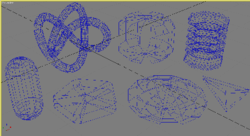
3ds Max Extended Primitives: Torus Knot (top left), ChamferCyl (acme center), Hose (top right), Capsule (bottom left), Gengon (lesser, second from left), OilTank (bottom, second from right) and Prism (lesser correct)
Standard primitives [edit]
| Box: | Produces a rectangular prism. An alternative variation of box called Cub proportionally constrains the length, width, and height of the box. |
| Cylinder: | Produces a cylinder. |
| Torus: | Produces a torus – or a ring – with a circular cross section, sometimes referred to as a doughnut. |
| Teapot: | Produces a Utah teapot. Since the teapot is a parametric object, the user can choose which parts of the teapot to display after creation. These parts include the body, handle, spout and hat. Primarily used to exam shaders (rendering settings). |
| Cone: | Produces upright or inverted cones. |
| Sphere: | Produces a full sphere, semi-sphere, or other portion of a sphere. |
| Tube: | Produces round or prismatic tubes. The tube is similar to the cylinder with a hole in it. |
| Pyramid: | Produces a pyramid with a square or rectangular base and triangular sides. |
| Airplane: | Produces a special type of apartment polygon mesh that can be enlarged by any corporeality at render time. The user can specify factors to magnify the size or number of segments or both. Modifiers such as displace tin can exist added to a plane to simulate a hilly terrain. |
| Geosphere: | Produces spheres and hemispheres based on three classes of regular polyhedrons. |
Extended primitives [edit]
| Hedra: | Produces objects from several families of polyhedra. |
| ChamferBox: | Produces a box with beveled or rounded edges. |
| OilTank: | Creates a cylinder with convex caps. |
| Spindle: | Creates a cylinder with conical caps. |
| Gengon: | Creates an extruded, regular-sided polygon with optionally filleted side edges. |
| Prism: | Creates a three-sided prism with independently segmented sides. |
| Torus knot: | Creates a complex or knotted torus by drawing 2D curves in the normal planes around a 3D curve. The 3D curve (chosen the Base Curve) can be either a circumvolve or a torus knot. Information technology can be converted from a torus knot object to a NURBS surface. |
| ChamferCyl: | Creates a cylinder with beveled or rounded cap edges. |
| Capsule: | Creates a cylinder with hemispherical caps. |
| L-Ex: | Creates an extruded L-shaped object. |
| C-Ext: | Creates an extruded C-shaped object. |
| Hose: | Creates a flexible object, similar to a spring. |
Rendering [edit]
- Scanline rendering
- The default rendering method in 3ds Max is scanline rendering. Several advanced features have been added to the scanliner over the years, such every bit global illumination, radiosity, and ray tracing.
- Art Renderer
- Autodesk Raytracer Renderer (ART) is a CPU-only, physically based renderer for architectural, production, and industrial design renderings and animations. It is integrated into 3ds Max as of version 2017.
- Redshift
- A third-party GPU-accelerated, biased renderer with plugins for 3ds Max, Cinema 4D, Houdini, Katana and Maya.
- Mental Ray
- Mental ray is a 3rd-party renderer using bucket rendering, a technique that allows distributing the rendering task for a single image between several computers. Since 3ds Max 2018, mental ray is no longer shipped with 3ds Max and needs to exist obtained directly from NVIDIA.
- RenderMan
- A third party connectedness tool to RenderMan pipelines is also available for those that demand to integrate Max into Renderman render farms. Used past Pixar for rendering several of their CGI animated films.
- V-Ray
- A 3rd-party render engine plug-in for 3ds Max.
- Brazil R/S
- A third-political party photorealistic rendering organization. It is capable of fast ray tracing and global illumination.
- Arion
- A third party hybrid GPU+CPU interactive, unbiased ray tracer, based on Nvidia CUDA.
- Indigo Renderer
- A third-political party photorealistic renderer with plugins for 3ds Max.
- Maxwell Render
- A third-party photorealistic rendering system providing materials and unbiased rendering.
- Octane Render
- A third political party unbiased GPU ray tracer with plugins for 3ds Max, based on Nvidia CUDA.
- Luxrender
- An open up-source ray tracer supporting 3ds Max, Cinema 4D, Softimage, and Blender. Focuses on photorealism by simulating real light physics equally much as possible.
- Arnold
- Arnold is an unbiased, physically based, unidirectional path-tracing renderer.
Corona Renderer
Corona Renderer is a modern high-performance (un)biased photorealistic renderer.
Licensing [edit]
Earlier versions (up to and including 3D Studio Max R3.1) required a special copy protection device (chosen a dongle) to be plugged into the parallel port while the programme was run, but later versions incorporated software based re-create prevention methods instead. Electric current versions require online registration.
Due to the high price of the commercial version of the program, Autodesk also offers a free student version, which explicitly states that it is to be used for "educational purposes but". The student version has identical features to the full version, but is only for single use and cannot be installed on a network. The student license expires subsequently 3 years, at which fourth dimension the user, if they are still a educatee, may download the latest version, thus renewing the license for another iii years.
See also [edit]
- Comparing of 3D estimator graphics software
- .3ds
- Autodesk Maya
- Blender
- Picture palace 4D
- Electrical Image Blitheness System
- Element 3D
- Lightwave 3D
- Modo
- Cyber Studio
References [edit]
- ^ a b c "Toolbox". Side by side Generation. No. 35. Imagine Media. November 1997. p. 27.
- ^ "Autodesk | 3D Design, Engineering & Entertainment Software"' Nov 21, 2013
- ^ "Autodesk 3ds Max — Detailed Features" Archived February 19, 2011, at the Wayback Machine, March 25, 2008
- ^ "History of Autodesk 3ds Max". Archived from the original on Oct 24, 2015.
- ^ "PC & Tech Authority". TechRadar.
- ^ "NURBS Curves and Surfaces", November 22, 2013
- ^ "Why is the Convex Hull property and so important". Stack Commutation. November 22, 2013.
- ^ "Metaballs/Blobby Objects", November 22, 2013
External links [edit]
- Official website

- 3D Studio Max at Curlie
- 3D Max Studio Form Benefits
Source: https://en.wikipedia.org/wiki/Autodesk_3ds_Max
0 Response to "3d max line drawing simulation"
Post a Comment